Getting Started
Install the tracking script on OnePage
Add the LeadJourney tracking script to a OnePage (onepage.io) project site-wide via Site Code, then publish – so every page view and form lead is tracked.

This guide shows you how to add the LeadJourney tracking script to a OnePage (onepage.io) project. OnePage has a built-in custom-code area, so no developer is needed – you paste the snippet once as Site Code (project-wide) and publish.
Prerequisites
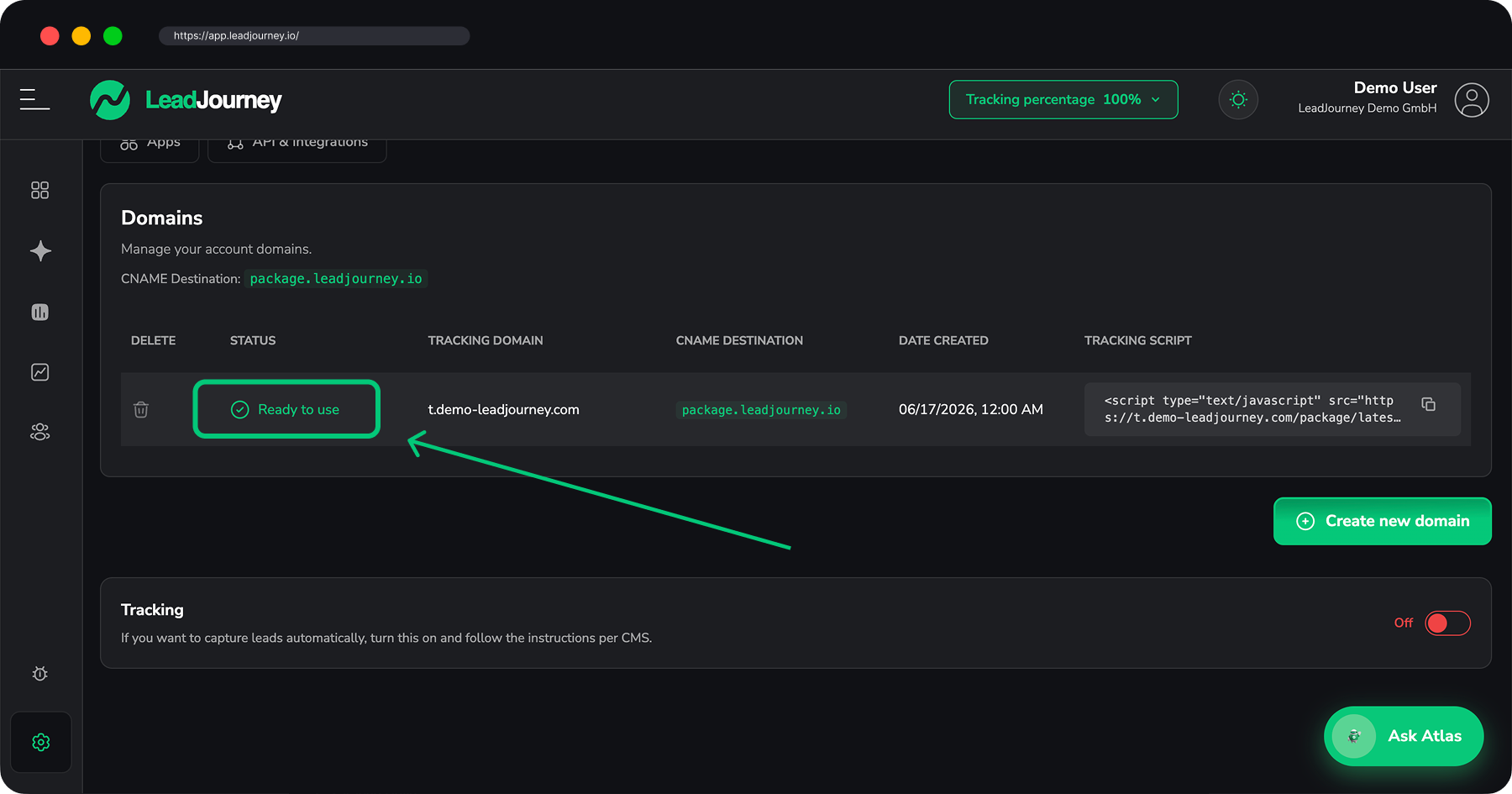
A tracking domain that shows Ready to use and your personal snippet from Settings → Tracking. If you haven't set those up yet, start with Set up your tracking domain and Install the tracking script.
Use Site Code, not Page Code
OnePage offers two scopes: Site Code applies to every page of your project, while Page Code only applies to the single page you're editing. Use Site Code so the script loads everywhere. Custom code also runs only on the published site served on your connected domain – not in the editor preview.
Step by step
Copy your snippet
Open Settings → Tracking and copy the snippet from the Tracking Script column. It contains your tracking domain and workspace ID and looks like this:
<!-- LeadJourney Tracking -->
<script type="text/javascript" async
  src="https://track.yourdomain.com/package/latest/YOUR-WORKSPACE-ID/"></script>
Use your own snippet
Always copy the snippet straight from your settings – the domain and workspace ID are unique to your account. The example above is just for illustration.
Open the custom-code panel
In the OnePage editor, open your project and click the code symbol (</>) in the left
sidebar. The custom-code window opens with two scopes – Page Code and Site Code – each
with three sections: <head>, <body> and Styles.
Site Code vs. Page Code
Choose Site Code so the script is added project-wide and loads on every page, including pages you create later. Only use Page Code if you want to track a single page.
Paste into Site Code → <head>
Switch to Site Code, select the <head> section and paste your snippet there
(<head> is the right place for tracking and background scripts). OnePage stores it with your
project.
Publish
Custom code only goes live when you publish. Click Update / Publish (Veröffentlichen) to push the change to your connected domain.
The editor preview doesn't run custom code
The script won't appear inside the OnePage editor or the preview – only on the published site on your connected domain. If you save but don't publish, nothing is tracked.
Verify tracking
Open your published OnePage site in a new browser tab, then return to Settings → Tracking. Once the first page views arrive, LeadJourney confirms the script is live.
Do OnePage forms fire a Lead?
OnePage multi-step forms and funnels live on a single page – the steps are sections, so
the URL doesn't change between them. The script's built-in MutationObserver follows those
step changes, and the formless-click fallback catches custom or embedded forms. For the
cleanest Lead signal, point the form's success action to a thank-you page that also
carries the Site Code snippet – that page view becomes your lead. See Track
events to fine-tune what counts as a lead.
Troubleshooting
Tracking not detected?
Check that your tracking domain is Ready to use, that you pasted your own snippet
(correct domain + workspace ID) into Site Code → <head> (not Page Code, not <body>),
and that you published to your connected domain (not just the editor preview). Open the
live page, view source (Ctrl/Cmd + U) and search for package/latest to confirm the
snippet is on the page. Also make sure a cookie-consent tool isn't blocking it.
Related articles
Install the tracking script on Wix
Add the LeadJourney tracking script to a Wix site site-wide via Custom Code, then publish – so every page view and form lead is tracked.
Install the tracking script on Perspective
Add the LeadJourney tracking script to a Perspective funnel via each step's Tracking Code, then publish – so every page view and lead is tracked.